
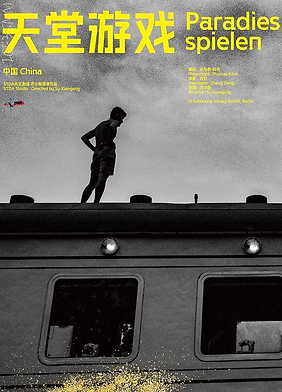
Paradies spielen

KillarB
Photographer:
Reviewer
Echo UK
20/06/2026
Overall Evaluation

Scriptwriting

Stage Design
Sound Design
Light Design
Playing Paradise, Losing Humanity — When Form Devours Meaning
Experimental theatre has always occupied a complicated position within contemporary performance. Its purpose is not simply to reject convention, but to question the assumptions that have long defined theatrical language. Every generation of artists searches for new forms capable of expressing a changing world. Yet formal innovation is never valuable in isolation. It succeeds only when it allows audiences to perceive familiar questions with renewed clarity. Paradies spielen is a production driven by admirable ambition and unmistakable intellectual curiosity. Beneath its dense theatrical vocabulary lies a thoughtful meditation on globalization, industrialization, and the gradual erosion of individual identity. Yet despite the strength of its conceptual foundation, the production repeatedly struggles to balance formal experimentation with dramatic necessity.
At its core, the work examines the relationship between human beings and systems. Modern society increasingly organizes life according to efficiency, circulation, and productivity. Individuals are standardized, classified, and absorbed into larger mechanisms of economic and social production. Commodities move freely across borders while people themselves become increasingly constrained by invisible structures of labor, technology, and consumption. Within this environment, personal identity begins to dissolve. What remains is no longer a complete individual but a functional component within a much larger machine.
It is a compelling premise, and one that feels urgently relevant.
Unfortunately, the theatrical language chosen to express these ideas often proves less convincing than the ideas themselves.
The first challenge emerges through the production’s sound design. Throughout the performance, electronic noise, amplified effects, industrial soundscapes, and continuous musical layers dominate the auditorium. Rather than creating tension or atmosphere, the sound frequently overwhelms both performers and spectators. Early in the performance, microphone feedback briefly interrupts the stage action, immediately breaking the audience’s concentration. More significantly, the persistent volume rarely allows moments of silence to develop. Instead of shaping rhythm, the soundscape flattens it.
Silence is one of theatre’s most powerful dramatic tools. Here, it is almost entirely absent.
The dramaturgical structure presents a similar problem.
Watching the performance, one cannot escape the feeling that the material has been expanded beyond its natural scale. The central ideas possess enough substance to support a concise and concentrated performance, yet the production repeatedly extends itself through accumulation rather than development. New theatrical elements continue to appear, but they rarely deepen the audience’s understanding of the central argument.
Magic tricks, acrobatic demonstrations, martial arts, pyrotechnic effects, rapid costume changes, and various displays of physical virtuosity are introduced throughout the evening. Individually, many of these moments are executed with remarkable precision. The performers display impressive technical versatility and obvious dedication. Yet collectively these sequences begin to compete with one another rather than forming a coherent theatrical language.
The production seems reluctant to trust the strength of its own ideas.
Instead of allowing individual images to resonate, it continually introduces new attractions. Every sequence strives to surprise. Every transition attempts to increase intensity. The result is a performance that frequently feels overproduced despite its genuinely meaningful thematic concerns.
Ironically, this formal strategy mirrors the very social condition the production seeks to criticize.
The work questions industrial systems built upon endless production and constant stimulation, yet its own theatrical structure begins to operate according to a similar logic. One effect follows another. One theatrical language immediately replaces the previous one. The audience receives an uninterrupted stream of visual and auditory information, leaving little opportunity for contemplation.
Rather than accumulating meaning, the production accumulates sensation.
The performers remain one of the evening’s greatest strengths.
The physical commitment required is extraordinary. Throughout the performance, the ensemble maintains remarkable energy while navigating a wide range of performance disciplines. Their control over movement, rhythm, and physical precision is consistently impressive. Equally demanding are the lengthy philosophical monologues that require sustained vocal intensity while communicating highly abstract ideas. Such writing offers performers few emotional resting points, yet the cast approaches these challenges with admirable discipline.
Among them, Xiao Qianqian and her stage partner stand out for their emotional clarity. Their performances provide some of the production’s most human moments, grounding abstract concepts in recognizable emotional experience. Whenever the production pauses long enough to allow these quieter moments to breathe, its central themes become significantly more powerful.
This makes the work’s greatest weakness all the more apparent.
Too often, Paradies spielen appears determined to demonstrate how experimental it can be. Formal innovation becomes a visible objective rather than an invisible method. Contemporary theatrical devices are assembled one after another almost as evidence of artistic ambition. The production embraces interdisciplinarity, participatory aesthetics, physical theatre, multimedia performance, and philosophical discourse, yet these elements do not always develop organically from the dramatic structure.
Experimentation itself becomes a kind of spectacle.
This is unfortunate because the production possesses genuine intellectual depth. Its reflections on labor, commodification, globalization, and the fragmentation of contemporary identity remain consistently engaging. The questions it raises deserve careful consideration. Yet the audience is rarely given sufficient time to absorb them before another theatrical intervention demands attention.
Theatre does not become more profound simply by becoming more complicated.
Some of the most powerful moments in contemporary performance emerge not through accumulation but through reduction. Formal restraint often allows ideas to resonate more deeply than constant innovation. The strongest experimental theatre does not seek novelty for its own sake; it discovers forms that reveal human experience with greater precision than conventional dramatic language can achieve.
Form should illuminate thought, not compete with it.
By the end of Paradies spielen, one is left with mixed emotions. There is much to admire: a fearless willingness to experiment, a talented ensemble capable of extraordinary physical performance, and an ambitious attempt to confront the anxieties of contemporary society. The production refuses easy answers and continually searches for new theatrical possibilities.
Yet its greatest obstacle lies within that same ambition.
In attempting to employ every available theatrical language, it occasionally forgets that audiences ultimately remember not the quantity of formal invention but the clarity of emotional and intellectual experience. The most memorable theatre is rarely the loudest or the busiest. It is the theatre that knows exactly when to speak, when to remain silent, and when to trust that a single truthful image can carry more weight than a hundred spectacular ones.
Paradies spielen comes remarkably close to becoming such a work. Beneath its layers of theatrical machinery lies a thoughtful and timely meditation on what it means to remain human within increasingly mechanized systems. Had it trusted that core with greater confidence—and exercised greater restraint in its formal ambitions—its philosophical questions might have landed with even greater force.
Ultimately, the production reminds us of an enduring truth about experimental theatre. Innovation is not measured by how many forms can coexist on stage, but by whether those forms lead us toward a deeper encounter with ourselves. When experimentation serves human experience, it expands the possibilities of theatre. When it merely accumulates techniques, form risks becoming another spectacle—one that dazzles the eye while leaving the heart just out of reach.
Director: Su Xiaogang
Playwright: Thomas Köck
Translator: Zhang Deng
Visual Designer: Deng Wen
Set Designer: Ma Shuaike
Composer: Li Xing
Producers: Wang Hao, Mei Xiaohan
Cast: Fu Jing, Zhao Liutong, Liu Yanan, Mo Yao, Jing Yacong, Tang Lining, Jin Jinlong, Du Yuhan
Vocalist: Zhang Tongxi (Selina)
Costume Designer: Du Jiang
Multimedia Designer: He Yuzhen
Sound Engineer: Zhai Jiaji
Stage Manager: Chai Jiawei
Photography & Videography: Mei Xiaoxue
Hair & Makeup Designers: Ren Wei, Yang Mengting
Lighting Operator: Bo Yuan
Publishing Rights: © Suhrkamp Verlag GmbH, Berlin